Jewellery Making Journal: Streamlining Your Creative Process and KDP Publishing
For artisans, metalsmiths, and beaders, the creative process extends far beyond the workbench. While the tactile act of shaping metal or stringing beads is central to the craft, the intellectual and logistical sides of jewellery making are equally vital for long-term success. A dedicated Jewellery Making Journal serves as the bridge between fleeting inspiration and tangible, reproducible results. Whether you are a hobbyist tracking personal growth or an entrepreneur preparing to publish low-content books on Amazon KDP, understanding the utility and structure of this specific type of journal is essential for maximizing productivity and profitability.
The Critical Role of Documentation in Craftsmanship
Jewellery making is a discipline of precision. Unlike painting or sculpture, where intuition often leads, creating wearable art requires exact measurements, specific material combinations, and repeatable techniques. Many makers face a common frustration: creating a stunning piece only to realize months later that they cannot replicate it because they failed to record the specific gauge of wire, the bead count, or the soldering temperature used. This is where a structured Jewellery Making Journal becomes indispensable.
Beyond simple replication, these journals address several key challenges in the artisan workflow:
- Inventory Management: Tracking precious metals and gemstones is financially necessary. A journal helps correlate material usage with finished pieces, aiding in accurate pricing and restocking.
- Design Evolution: Sketches and notes allow makers to iterate on designs before committing expensive materials to the final product.
- Technical Troubleshooting: Recording failures is as important as recording successes. Noting why a bezel didn't sit flush or why a glaze cracked prevents costly future mistakes.
- Business Compliance: For those selling their work, maintaining records of production costs, time spent, and sales channels is crucial for tax purposes and business scaling.
By centralizing this information, the Jewellery Making Journal transforms from a simple notebook into a comprehensive database of your artistic career.
Leveraging Pre-Made Interiors for Amazon KDP
For creators looking to monetize their organizational systems or provide resources to the maker community, the Jewellery Making Journal has taken on a second life as a popular niche on Amazon Kindle Direct Publishing (KDP). Instead of designing a layout from scratch, many publishers utilize pre-made KDP interiors. These ready-to-use files significantly reduce the barrier to entry for self-publishers.
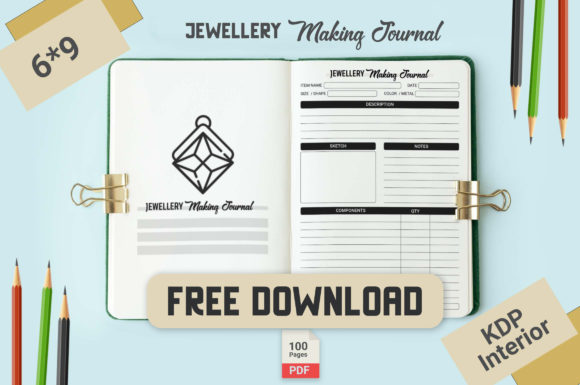
A high-quality Jewellery Making Journal KDP interior typically includes specific features designed for immediate upload and professional printing. When selecting or utilizing these resources, it is vital to understand the technical specifications that ensure a seamless publishing experience:
- Editable Source Files: Access to 100 editable Illustrator AI files allows publishers to customize covers, add branding, or modify prompts to create unique variations rather than publishing duplicate content.
- Standard Trim Size: The 6×9 inch format is the industry standard for trade paperbacks. It offers ample writing space while remaining portable enough to fit in a studio bag or tote.
- Print-Ready PDFs: High-resolution interiors ensure that lines, grids, and text remain crisp after printing. Blurry templates lead to poor customer reviews and returns.
- No Bleed Configuration: Most functional journals utilize a no-bleed setup, keeping all content safely within the margins. This simplifies the upload process and reduces the risk of formatting errors during KDP review.
Using these pre-formatted assets allows publishers to focus on keyword research, cover design, and marketing rather than spending dozens of hours on typesetting and grid alignment.
Practical Applications for Makers and Publishers
The versatility of the Jewellery Making Journal means it serves two distinct audiences with overlapping needs. Understanding how each group interacts with the product helps in both using and marketing it effectively.
For the Working Artisan
The primary user of this journal is the maker. Their approach is functional and data-driven. They utilize the journal to create "project sheets" that document every aspect of a creation. Practical application involves filling out sections for material costs, labor hours, and wholesale/retail pricing formulas immediately upon completing a piece. This habit ensures that no item is sold at a loss due to uncalculated overhead.
Additionally, serious makers use the journal for collection planning. Before starting a new seasonal line, they use the sketch pages to visualize cohesion between pieces. This strategic planning phase, documented in the journal, often leads to more successful product launches and stronger brand identity.
For the KDP Publisher
Publishers approach the Jewellery Making Journal as a product solution. Their goal is to identify gaps in the current market. While generic notebooks exist, successful publishers look for opportunities to add value through specificity. For example, using the editable AI source files to create a version specifically for "Silversmiths" versus one for "Polymer Clay Artists" targets different sub-niches with tailored terminology and relevant tracking fields.
Publishers also use these journals as lead magnets or complementary products. A jewellery instructor might bundle a digital version of the journal with an online course, or use the physical KDP book as a textbook for workshop students. The print-on-demand nature of KDP makes this inventory-free business model highly attractive for educators and influencers in the craft space.
Maximizing Value Through Customization and Implementation
Whether you are downloading a file to publish or buying a journal to use, customization is key to extracting maximum value. A generic template is a starting point, but personalization creates longevity.
For Publishers: Do not simply upload the stock PDF. Use the included Illustrator files to add a unique introduction, tips for jewellery photography, or conversion charts for bead sizes. These value-adds differentiate your book from competitors using the same base interior. Consider adding QR codes that link to video tutorials or supplier lists, transforming the static journal into an interactive resource.
For Users: Create a legend or index system within your journal. Color-coding entries by project status (e.g., green for completed, yellow for in-progress, red for stalled) allows for quick visual reference. Dedicate the first few pages to a master supply list or a glossary of techniques. Over time, your Jewellery Making Journal becomes a personalized encyclopedia of your craft.
Considerations for Quality and Longevity
When engaging with Jewellery Making Journals, quality assurance is paramount. For KDP interiors, always verify the resolution of the downloaded PDF. Text should be vector-based or at least 300 DPI to prevent pixelation. Check that the margins account for the page count; a 100-page book requires different gutter margins than a 300-page book to prevent text from falling into the binding.
For end-users, consider the physical durability required for a studio environment. Jewellery making can be messy, involving polishing compounds, acids, and oils. While KDP produces standard paperback books, users may wish to protect their journal with a clear adhesive cover or keep it in a plastic sleeve while working at the bench. Choosing a matte finish over glossy for the cover can also reduce glare under bright studio lighting and resist fingerprint smudges better during active use.
Building a Sustainable Creative Habit
Ultimately, the Jewellery Making Journal is a tool for sustainability. For the maker, it sustains the business by ensuring profitability and preserving technical knowledge. For the publisher, it sustains a passive income stream by solving a specific organizational problem for a passionate niche audience.
Success with this tool comes from consistency. Makers should aim to spend five minutes documenting after every work session. Publishers should aim to release updated versions annually, incorporating feedback from user reviews to improve layouts and add requested features. By treating the journal as a living document rather than a static product, both creators and sellers can build a foundation for lasting achievement in the jewellery arts.
The integration of organized documentation into the creative workflow marks the transition from amateur enthusiast to professional artisan. Whether utilized as a personal studio companion or published as a resource for others, the Jewellery Making Journal remains a cornerstone of efficient, profitable, and mindful craftsmanship.