Designing and Publishing a Professional Phone Call Log Book for KDP Interior Success
The landscape of Amazon Kindle Direct Publishing (KDP) has evolved significantly, moving beyond simple lined journals to specialized, functional tools that serve specific professional and personal needs. Among these high-utility low-content books, the phone call log book stands out as a perennial staple for businesses, researchers, and organized individuals. Creating a successful product in this niche requires more than just placing lines on a page; it demands a strategic approach to interior design, technical specifications, and user experience. Understanding the nuances of a Phone Call Log Book for KDP Interior is essential for publishers aiming to provide genuine value rather than adding to digital clutter.
Functional Anatomy of an Effective Communication Tracker
A high-quality logbook interior must balance data density with writing comfort. Unlike a standard notebook, a communication tracker serves as a legal or operational record. The layout must facilitate quick entry while ensuring all critical metadata is captured. When designing or selecting a template, the column structure dictates the book's utility. Essential fields typically include date, time, caller name, organization, phone number, incoming/outgoing status, duration, and a notes section. However, superior interiors often include additional columns for "action required," "follow-up date," or "outcome," transforming the book from a passive record into an active workflow management tool.
Spacing is equally critical in the design phase. A common failure in low-content publishing is cramming too many rows onto a single page to maximize perceived value. In reality, users require adequate vertical space to write legibly, especially when documenting complex conversations. An 8.5×11 inch dimension provides ample real estate for wide margins and generous row height. This size accommodates both brief check-ins and detailed consultation notes without forcing the user to cramp their handwriting. Furthermore, considering the binding margin (gutter) is vital; a well-designed interior accounts for the space lost to binding, ensuring that text near the spine remains readable and writable.
Technical Specifications for Print-Ready Production
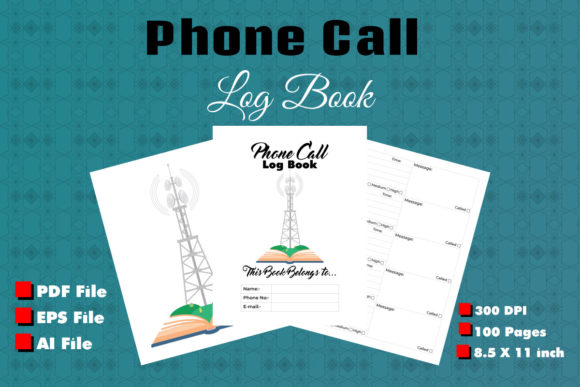
Transitioning from concept to a physical product requires strict adherence to printing standards. For a standard Phone Call Log Book for KDP Interior, the "No Bleed" setting is generally preferred. This means all content, including borders and table lines, stays within the safe zone, maintaining a consistent white margin around the perimeter. This choice simplifies the upload process and reduces the risk of critical elements being trimmed during manufacturing. The industry-standard specification for this type of logbook is 102 pages. This count strikes an optimal balance between substantial utility and cost-efficiency, keeping the royalty potential healthy while providing enough volume for months of daily tracking.
File format integrity is non-negotiable. While source files may exist in AI (Adobe Illustrator) or EPS formats for editing flexibility, the final deliverable for KDP must be a high-resolution PDF. Vector-based PDFs are superior to rasterized JPGs because they maintain crisp line quality at any zoom level and result in smaller file sizes with faster processing times. When preparing the print-ready file, publishers must verify that the color profile is set correctly—typically grayscale for black-and-white interiors—to avoid unexpected color shifts or rejection during the automated review process. Ensuring the PDF is flattened and embedded prevents font substitution issues that could ruin the alignment of tables and headers.
Diverse Applications Across Professional Sectors
The market for communication logs extends far beyond generic office use. Identifying specific sub-niches allows creators to tailor their interiors and marketing to distinct audiences. Legal professionals, for instance, require billing-centric layouts where call duration is prominently displayed alongside client matter numbers for accurate invoicing. These users prioritize precision and archival quality over aesthetic flourishes. Conversely, real estate agents benefit from lead-tracking variations that include fields for property addresses, buyer status, and next steps, integrating the call log directly into their sales pipeline.
In the healthcare and social work sectors, phone logs serve as compliance and continuity-of-care documents. Interiors designed for these fields often emphasize confidentiality and structured note-taking areas that align with case management protocols. Similarly, small business owners and solopreneurs utilize these books for customer service tracking and vendor management. For this demographic, the logbook acts as a centralized CRM alternative that does not rely on internet connectivity or software subscriptions. Educators and school administrators also represent a significant user base, using call logs to document parent communications, disciplinary discussions, and student welfare checks, where having a tangible, timestamped record is essential for accountability.
Strategic Advantages of Specialized Low-Content Assets
For self-publishers, utilizing pre-designed, professional-grade templates offers significant operational leverage. Creating a 102-page interior from scratch involves hours of grid setup, master page configuration, and export testing. Accessing a verified Phone Call Log Book for KDP Interior template drastically reduces this production time, allowing publishers to focus on keyword research, cover design, and marketing strategy. This efficiency is particularly valuable when building a portfolio of related productivity tools, such as meeting planners, visitor logs, or dispatch trackers.
Beyond time savings, professionally engineered interiors mitigate technical risks. Templates described as "ready to upload" have typically been tested against KDP’s current margin and bleed requirements. This reduces the likelihood of manuscript rejection, which can delay publication by days or weeks. Furthermore, high-quality designs incorporate subtle UX improvements—such as alternating row shading for readability, clear header hierarchy, and intuitive iconography—that distinguish a premium product from amateur competitors. These design choices signal expertise to the potential buyer, reinforcing the perception of value even in a low-content category.
Optimizing User Experience Through Layout Design
The longevity of a logbook depends entirely on whether the end-user finds it frictionless to maintain. Designers must anticipate how the book will be used in real-world environments. For example, including a "Year" and "Month" field on every page, rather than just the cover, allows users to start the book at any time and reference past entries easily. Index pages or monthly summary tabs can further enhance navigation, turning a chronological list into a searchable database. These structural additions transform a basic commodity into a sophisticated organizational system.
Typography plays a silent but crucial role in usability. Sans-serif fonts like Arial, Helvetica, or Open Sans are generally preferred for table headers and labels due to their legibility at small sizes. Line weight also matters; heavy black lines can feel oppressive and distract from handwritten content, while light gray lines recede visually, allowing the user's ink to take center stage. Testing different line weights and opacities ensures the printed result is functional rather than decorative. Additionally, leaving intentional white space for "miscellaneous notes" or "daily totals" acknowledges that structured data entry rarely captures the full context of human communication.
Navigating Market Saturation with Quality Standards
As the low-content publishing space matures, quality has become the primary differentiator. Simply uploading a generic grid is no longer sufficient to capture market share. Successful publishers treat the Phone Call Log Book for KDP Interior as a component of a broader brand identity. Consistency in trim size, page count, and visual style across a series of logbooks encourages repeat purchases and builds author recognition. Bundling complementary interiors—such as pairing a phone log with a mileage tracker or expense journal—can also increase average order value and improve visibility through cross-promotion.
Originality in design protects against commoditization. While standard fields are necessary, unique arrangements or proprietary layouts can create a defensible market position. Publishers should conduct thorough competitive analysis to identify gaps in existing offerings. Perhaps current options lack adequate space for international phone numbers, or they fail to include AM/PM indicators. Addressing these micro-frustrations demonstrates a deep understanding of the user’s needs. Ultimately, the goal is to produce a resource that feels custom-made for its intended audience, validating the continued relevance of physical logging tools in an increasingly digital world.
Considerations for Digital and Hybrid Workflows
While KDP primarily serves the print-on-demand market, the versatility of source files like AI, EPS, and PDF extends the product's lifecycle. Some creators repurpose high-quality interiors as digital downloads for tablet users who prefer stylus-based note-taking apps. Adapting a print-ready Phone Call Log Book for KDP Interior for digital use may involve adjusting aspect ratios or adding hyperlinked tabs, but the core design principles remain valid. This hybrid approach maximizes the return on investment for each design asset.
Furthermore, understanding the distinction between "low content" and "no content" is vital for accurate categorization and customer satisfaction. A phone log book is definitively low-content because it contains structured prompts and repetitive frameworks, whereas a blank notebook is no-content. Misclassifying these products can lead to poor discoverability and negative reviews. Publishers must ensure their metadata accurately reflects the interior’s complexity. Providing detailed previews of the interior pages in the product listing helps manage expectations and reduces returns, ensuring that buyers understand exactly what functional tools they are purchasing.