Cocktail Recipe Journal: Evaluating a 100-Page KDP Interior for Print on Demand
The low and no-content book market on Amazon KDP has matured significantly, shifting away from generic lined notebooks toward specialized, niche-specific interiors. For publishers and creators targeting the home bartending and mixology community, a dedicated Cocktail Recipe Journal represents a functional asset rather than a novelty item. This specific digital resource provides a pre-formatted, 100-page interior designed explicitly for documenting drink formulations, tasting notes, and ingredient ratios. Understanding the technical specifications and practical utility of this file is essential for determining its viability in a competitive Print on Demand (POD) landscape.
Functional Design and User Experience
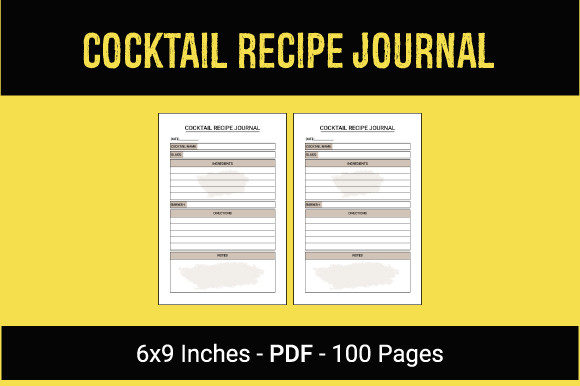
The primary value proposition of any KDP interior is its usability. A cocktail journal differs fundamentally from a standard recipe book because it must accommodate liquid measurements, garnish notes, and sensory evaluations. This 100-page template addresses those specific needs through structured data entry points. Rather than forcing users to adapt blank lines to complex recipes, the layout provides designated fields for spirits, modifiers, sweeteners, and bitters. This structural intentionality reduces friction for the end user, which is a critical factor in generating positive reviews and repeat customers.
From a design perspective, the interior balances writing space with visual hierarchy. The 6″ x 9″ trim size is the industry standard for this category, offering enough surface area for detailed notation while remaining portable enough for use behind a bar or at a social gathering. The "No Bleed" specification is a significant practical advantage for KDP publishers. By keeping all content within the safe margin, this file eliminates the risk of text being trimmed during the printing process. This reliability is crucial for maintaining professional quality control, as bleed errors are a common cause of rejected manuscripts or poor customer experiences in POD publishing.
Evaluating the 100-Page Count Strategy
The decision to utilize exactly 100 pages is strategic rather than arbitrary. In the KDP ecosystem, page count directly influences printing costs and royalty margins. A 100-page book typically sits in a lower cost bracket than thicker volumes, allowing for more competitive pricing or higher profit margins. For a cocktail journal, this length is sufficient to document a comprehensive personal repertoire without becoming unwieldy. Users are more likely to complete and value a concise, focused journal than an intimidating 300-page tome that remains largely empty. This psychological aspect of product design often translates to better market performance.
Technical Specifications and Production Quality
Digital assets for POD must meet rigorous technical standards to ensure the final physical product meets consumer expectations. This Cocktail Recipe Journal is delivered as a high-resolution PDF, which is the required format for Amazon KDP upload. High resolution is non-negotiable for interior pages containing lines, boxes, or typography; pixelation or blurriness immediately signals low quality to buyers. The crispness of the lines and the legibility of the text headers in this file suggest it was generated at the appropriate DPI (typically 300 or higher) for print production.
- Dimensions: 6″ x 9″ inches, optimized for standard trade paperback binding.
- Page Count: 100 pages, balancing capacity with cost-efficiency.
- Bleed Settings: No Bleed, ensuring all elements remain within safe print margins.
- File Format: High-Resolution PDF, ready for direct upload without conversion.
- Content Type: Structured mixology templates including measurement guides and tasting wheels.
The "No Bleed" configuration also simplifies the cover creation process. Publishers do not need to account for wrap-around interior elements when designing their exterior cover, reducing the complexity of the overall project setup. This streamlines the workflow for freelancers and small business owners managing multiple titles, allowing for faster iteration and testing of different cover designs against the same reliable interior.
Market Positioning and Audience Fit
This interior is best suited for publishers who understand the distinction between general cooking enthusiasts and serious cocktail hobbyists. The target demographic includes home bartenders, aspiring mixologists, hospitality professionals tracking R&D, and gift buyers looking for functional accessories. The structured nature of the pages appeals to users who treat mixology as a discipline requiring precision and record-keeping, rather than casual experimentation.
For marketers and creators, this asset serves as a foundation for building a brand around beverage education or lifestyle content. It can be bundled with digital courses, used as a lead magnet, or sold as a standalone companion to a blog or YouTube channel. However, success depends heavily on differentiation. Because the interior is a ready-to-use file, other publishers may access identical layouts. Value must therefore be added through unique cover design, compelling metadata, and targeted marketing. The interior provides the functional baseline; the publisher provides the context and appeal.
Practical Limitations and Considerations
While the Cocktail Recipe Journal offers significant utility, objective evaluation requires acknowledging limitations. As a pre-made template, it lacks customization options. Publishers cannot easily add their own logo, modify field labels, or adjust spacing without graphic design skills and source files. If the target audience requires specific proprietary sections—such as cost analysis for commercial bars or pairing notes for restaurant menus—this generic template may be insufficient.
Additionally, the saturated nature of the KDP journal market means that simply uploading this file is unlikely to generate sales. The "ready to use" aspect lowers the barrier to entry, which simultaneously increases competition. Publishers should view this file as a component of a broader strategy rather than a passive income solution. Testing different niches within the cocktail space (e.g., tiki drinks, mocktails, historical recipes) using this standard interior can help identify underserved segments where the generic layout still feels relevant.
Workflow Integration and Publishing Efficiency
For entrepreneurs and freelancers managing a portfolio of KDP titles, efficiency is a key metric. This digital file integrates seamlessly into standard publishing workflows. The absence of bleed issues means less time spent troubleshooting previewer errors or re-uploading corrected files. The standardized 6x9 size aligns with most cover design templates and mockup generators available in the marketplace. This compatibility reduces the cognitive load associated with launching new products.
The consistency of the interior also aids in series creation. Publishers can develop a recognizable brand identity across multiple journals (e.g., Wine Tasting, Beer Brewing, Coffee Cupping) by using similarly formatted interiors from the same source or style family. This visual and functional coherence helps build customer loyalty and encourages cross-purchases. The Cocktail Recipe Journal, therefore, functions not just as a single product but as a potential anchor in a wider catalog of beverage-related logbooks.
Assessing Long-Term Value and ROI
The return on investment for a ready-to-use KDP interior depends on volume, pricing strategy, and marketing effectiveness. At a low price point, this asset allows for rapid prototyping of market demand. Publishers can test whether a specific sub-niche responds to this layout before investing in custom design work. If the title performs well, the initial cost of the digital file is quickly recouped. If it underperforms, the financial risk remains minimal compared to hiring a designer for a bespoke interior.
Long-term value is also tied to the evergreen nature of the content. Unlike trend-based journals tied to specific years or events, a cocktail recipe journal has perpetual relevance. People will continue to mix drinks and seek organization regardless of seasonal shifts. This durability makes it a suitable asset for publishers focused on building sustainable, long-tail revenue streams rather than chasing short-term trends. The high-resolution quality ensures the file remains usable even if printing standards evolve, protecting the initial investment.
Final Assessment for Serious Publishers
The Cocktail Recipe Journal 100-page interior represents a competent, technically sound resource for the KDP publisher. Its strengths lie in its specific functional design, safe production specifications, and alignment with current market preferences for structured over blank journals. It solves the immediate problem of needing a professional-grade mixology logbook without the time or expense of custom development.
However, it is a tool, not a guarantee. Its effectiveness is entirely dependent on how it is packaged, positioned, and marketed. Professionals should evaluate this asset based on their specific business goals: it is excellent for scaling production, testing niches, and maintaining consistent quality across a catalog. It is less suitable for those seeking total exclusivity or highly specialized commercial features. For the pragmatic publisher willing to invest effort in differentiation and audience targeting, this interior provides a reliable foundation for a viable print-on-demand product.